Technical Note No. 74/2026 sets out the transition through August 2027 and outlines preparation steps for sponsors, CROs, and research sites.
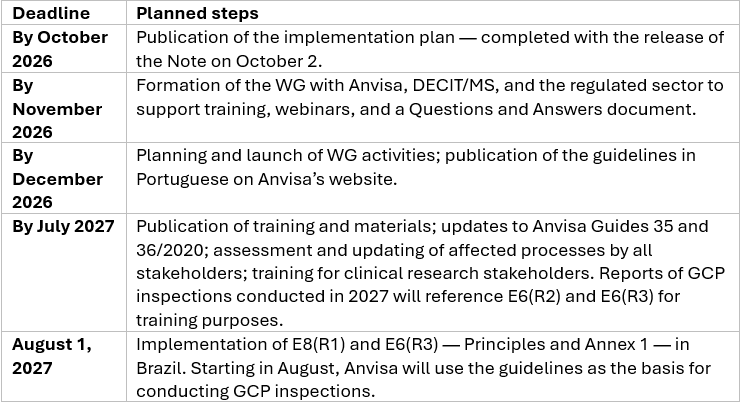
Key milestone: Starting August 1, 2027, Anvisa will use the ICH E8(R1) and E6(R3) guidelines ? Principles and Annex 1 ? as the basis for Good Clinical Practice inspections. The Note also allows clinical research stakeholders to adopt the updated guidelines before that date. [1]
Clinical research in Brazil now has a new transition framework. Published on October 2, 2026, Technical Note No. 74/2026/SEI/COPEC/DIRE2/Anvisa presents the plan for implementing ICH E8(R1), on general considerations for clinical studies, and ICH E6(R3) ? Principles and Annex 1, on Good Clinical Practice (GCP). The document combines an implementation milestone with preparatory steps involving training, updated materials, and process reviews. [1, 2]
For sponsors, contract research organizations (CROs), research sites, and professionals involved in clinical trials, the timeline provides a defined period to understand the changes and plan their application. Preparation can begin now: the Note itself clarifies that early adoption of the guidelines is permitted.
Why did Anvisa publish an implementation plan?
ICH brings together regulatory authorities and pharmaceutical industry representatives to harmonize technical guidance related to the development of medicines for human use. Anvisa reports that ICH published E8(R1) in 2021 and the Principles and Annex 1 of E6(R3) in January 2025. In May 2026, the Agency held a workshop with Sindusfarma on the impact of these guidelines in Brazil. The Note cites the substantial changes and the input received during the event as part of the rationale for gradual, organized implementation. [1, 2]
Implementation will be coordinated by an Anvisa working group (WG), with support from the Ministry of Health?s Department of Science and Technology (DECIT/MS) in developing materials and training. The Note also provides for participation by representatives of clinical trial sites, clinical research professionals, sponsors, and CROs through associations or institutions connected to these stakeholders. [1]
How is the approach to clinical studies changing?
The two guidelines complement each other. E8(R1) guides study planning and design; E6(R3) updates the Good Clinical Practice principles and recommendations for conducting studies. Together, they reinforce an integrated approach to quality, participant protection, and reliable results throughout the study life cycle. [3, 4]
ICH E8(R1): Building quality into study design
E8(R1) recommends incorporating quality into design and planning decisions, rather than relying solely on reviews conducted after a study is already underway. This includes defining clear scientific objectives, assessing operational feasibility, and identifying critical-to-quality factors ? those whose integrity is essential to protecting participants and producing reliable, interpretable results. [3]
Once these factors have been identified, the sponsor and team can direct controls and resources toward risks that could compromise them. The intensity of procedures should be proportionate to study risks and the importance of the information collected. Quality by design therefore means justifying priorities from the protocol stage and monitoring their implementation.
ICH E6(R3): Good clinical practice focused on fitness for purpose and risk
The Principles and Annex 1 of E6(R3) update the GCP framework to address different clinical trial settings and methodological and technological advances. The guideline continues to place ethical conduct, participants? rights, safety, and well-being, and the generation of reliable results at its core. It also emphasizes risk-proportionate approaches and fit-for-purpose solutions, including data governance and oversight of study activities. [4]
In practice, E8(R1) and E6(R3) encourage teams to connect what is essential to the scientific question and participant protection with the responsibilities, processes, and controls used during study conduct. Proportionality directs attention to what is critical for each study while maintaining ethical and scientific standards.
Timeline outlined in Technical Note No. 74/2026
The Note states that Brazil?s implementation plan for Annex 2 of ICH E6(R3) will be published at a later date. [1]
How sponsors, CROs, and research sites can prepare
The actions below are GRINN?s practical recommendations for organizing the transition; they should not be interpreted as additional requirements beyond those described in the Technical Note.
? Map the scope. Identify studies in planning and those already underway, the stakeholders involved, and the processes that may be affected. Document which activities fall under the responsibility of the sponsor, CRO, site, and service providers.
? Conduct a gap analysis. Compare current processes with the concepts in the guidelines: critical-to-quality factors, proportionate risk management, oversight, responsibilities, and the data and systems used in the study. Prioritize gaps that could affect participants or the reliability of results.
? Plan updates and role-based training. Review procedures and materials as Anvisa publishes the Portuguese versions and the WG?s guidance. Organize training aligned with the responsibilities of investigators, site teams, sponsors, CROs, and vendors.
? Define a transition strategy. For each study, establish how to assess early adoption or transition by August 2027, specifying responsible parties, deadlines, and records of decisions. This helps maintain consistency across the protocol, processes, and execution.
Consider the scope for medical devices
The Note addresses the adoption of ICH guidelines for clinical research on medicines for human use and was issued by the Coordination of Clinical Research in Medicines and Biological Products. Therefore, the timeline should not be assumed to apply automatically to every clinical investigation of medical devices. This interpretation follows from the scope described in the document; applicability must be assessed based on the product category, study design, and relevant regulatory requirements. [1, 3, 4]
A transition that begins with planning
Anvisa?s timeline makes preparation a shared priority. Implementation depends on materials and training, but also on each organization?s ability to translate principles into processes consistent with its studies, risks, and responsibilities. Starting with scope mapping now allows time to identify gaps, align teams, and track the guidance to be published through 2027.
For GRINN, the update reinforces the importance of integrating clinical strategy, quality, data management, and regulatory analysis from the study design stage. Thorough preparation begins with a focused question: which factors are truly critical to protecting participants and confidently answering the study?s scientific question?
Has your organization begun assessing the processes that may be affected by E8(R1) and E6(R3)? Contact GRINN to discuss next steps, taking into account the regulatory scope applicable to your product and study.